Artificial intelligence is already changing the way policy professionals research, analyze data and communicate their work. For students preparing to enter the field, that raises the more immediate question of what employers will need from them that AI cannot provide.
The School of Public Policy brought together experts to discuss how AI is affecting the labor market and what those changes could mean for students entering the workforce. Dean Gustavo Flores-Macías welcomed attendees by acknowledging both the questions and anxiety surrounding AI and the future of work. “AI will almost certainly be part of that future,” said Flores-Macías. “The more important question then is what kinds of skills will distinguish excellent work.”
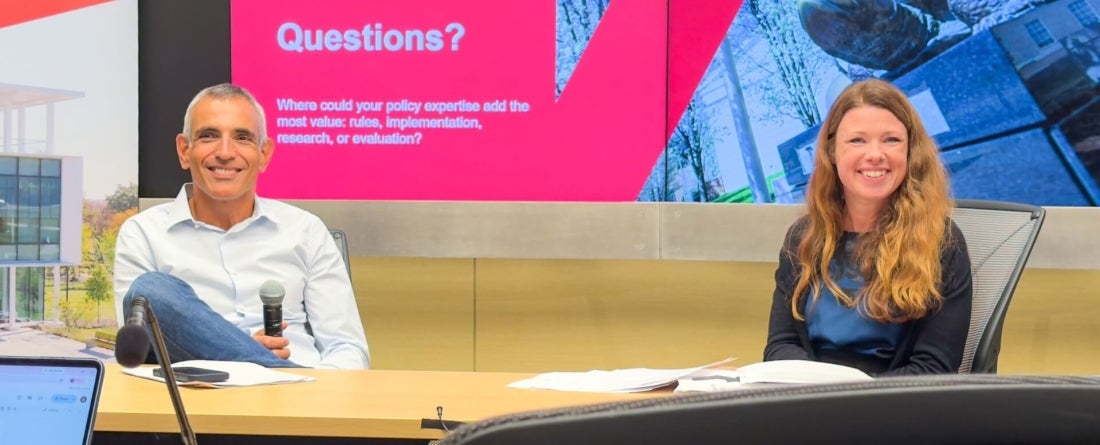
The event speakers included Stéphane Carcillo, head of the Jobs and Income Division at the Organisation for Economic Co-operation and Development (OECD), and Sarah Newman, an SPP doctoral student and senior researcher at the American Institutes for Research (AIR). Professor Doug Besharov moderated the discussion.
Carcillo provided an evidence-based look at what researchers know, and still do not know, about AI’s effects on employment. While some research has raised concerns about employment prospects for young workers in occupations highly exposed to AI, he emphasized that the evidence remains mixed. He also noted that the weakening labor market advantage for young college graduates began before the introduction of large language models, making it difficult to attribute recent employment trends solely to AI.
What is clearer, Carcillo said, is that AI is better suited to some tasks than others. Routine work such as data entry, transcription and standard document production is more susceptible to automation, while work requiring judgment, creativity, collaboration and deep subject-matter expertise is harder to replace. “You need to exert judgment when you actually use AI products,” he said. “You need to challenge AI answers to be able to be augmented by AI rather than just being replaced.”
You need to exert judgment when you actually use AI products. You need to challenge AI answers to be able to be augmented by AI rather than just being replaced.Stéphane Carcillo
Carcillo encouraged students to build what he called a “mental library” of policies, methods and evidence. AI can help researchers find information, analyze data and test ideas, he said, but policy professionals still need enough expertise to recognize flawed assumptions, questionable sources or incorrect results.
The conversation reflects the School’s work in science, technology and AI. As one of the School’s six strategic focus areas, science and technology policy brings together expertise across disciplines and sectors to advance policy solutions for emerging technologies and help shape how they serve the public good. The university is also advancing interdisciplinary AI research and education through the Artificial Intelligence Interdisciplinary Institute at Maryland (AIM), which focuses on the responsible development and use of AI.
From the broader discussion of AI and the workforce, Newman then turned to what these changes could mean for policy careers in the U.S., drawing on her experience in the federal government and at AIR. She described AI as both creating new areas of policy work and changing existing jobs, including some routine tasks traditionally assigned to entry-level employees. She shared that research organizations and think tanks are already forming AI-focused teams and looking for employees with AI literacy.
For students preparing to enter the changing workplace, Newman emphasized curiosity, attention to detail and an understanding of context when working with AI. The technology can make certain tasks faster, she said, but people still need to check its work and take responsibility for how it is used. “They have to do the framing,” Newman said of policy professionals. “They have the responsibility to the constituents, not the machine.”