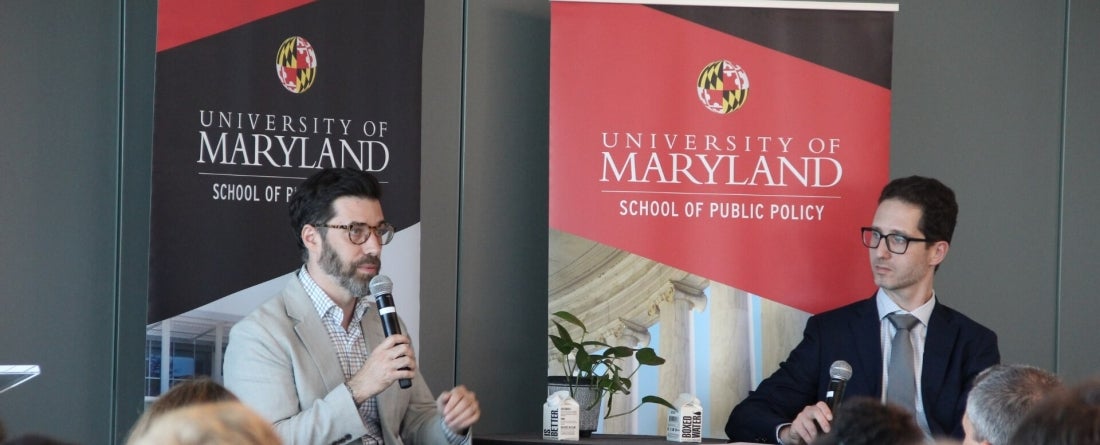
The familiar map of the United States tells only part of the story. For much of its history, U.S. power has extended well beyond the 50 states through overseas territories and, today, a vast network of military bases. The School of Public Policy welcomed Daniel Immerwahr, author of this year’s University of Maryland First Year Book “How to Hide an Empire: A History of the Greater United States,” for a discussion of what America’s territorial history can tell us about U.S. foreign policy and its role in the world today. Professor Josh Shifrinson joined Immerwahr to explore how looking beyond the traditional map of the United States can change the way we understand American power and influence abroad.
Immerwahr said his book grew from a realization that overseas territories were often treated as peripheral to the American story despite their influence on both U.S. and global history. “This is not an attempt to condemn the United States for having an empire,” said Immerwahr. “It’s an attempt to analyze the United States for having an empire.”
This is not an attempt to condemn the United States for having an empire. It’s an attempt to analyze the United States for having an empire.Daniel Immerwahr
That broader view has implications for contemporary policy. The United States today has five inhabited territories and hundreds of military bases around the world, giving it a physical presence in other countries that can carry political, economic and cultural consequences. Immerwahr argued that those bases have played an important but often overlooked role in shaping U.S. relationships abroad.
The discussion ranged from America’s territorial history to questions facing policymakers today, including the status of U.S. territories, the country’s military footprint abroad and the role the United States should play in the international system. Shifrinson framed the conversation around what America’s history as an empire can tell us about foreign policy at a time when its global role is in flux.
Immerwahr also challenged the idea that America’s involvement in world affairs was simply an inevitable outgrowth of its history. “This was a choice,” he said. “And seeing it that way makes it easier to ask the question, was it the right choice then, and is it the right choice now?”
That same scrutiny, he argued, should extend to individual policy decisions. When the United States intervenes abroad or maintains a military presence in another country, policymakers should consider not only the broader strategic objective but how those decisions will play out on the ground and what unintended consequences could follow. He described the approach as a kind of “global impact audit” that accounts for the practical details and second-order effects of U.S. actions abroad.
Audience questions broadened the conversation to foreign aid, climate change, Puerto Rico, emerging technologies, U.S. alliances and the future of American global leadership. Immerwahr emphasized the historical significance of U.S. territories, which he said are “not just footnotes, but actually engines of history.”