
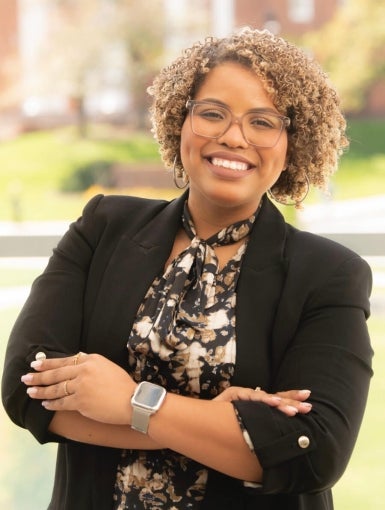
On the first day of one of her first classes as a graduate student, Mabel Zuñiga Quintero heard Clinical Professor Betty Duke describe public policy as the work of addressing “wicked problems.” That phrase—and the responsibility that comes along with it—resonated with Zuñiga , who this summer, put that to the test as part of a multi-national, multi-disciplinary team tackling sustainability.
“Sustainability challenges are a perfect example of wicked problems. They are complex, interconnected and do not have one simple solution,” she said. “Bringing that perspective to U21 helped me think more intentionally about how we design and implement policies, who participates in those processes and what it actually means to pursue sustainability without leaving people behind.”
As one of two students nominated by the University of Maryland, Zuñiga traveled to Ontario, Canada to participate in the four-day U21 School for Sustainable Policy Leadership at McMaster University. There, she joined a cohort of post-baccalaureate students from computer science, health, engineering, democracy studies, administration, politics, public policy and other fields. The 60-person group brought their eclectic expertise to the table to think more broadly about sustainability: where the biggest challenges are, what factors influence whether sustainable policies succeed or fail and how we can design and implement them more effectively.
That interconnected approach is exactly what Zuñiga noted is needed to solve the “wicked problem” of climate instability. Originally from Panama and with a background in climate policy before starting at UMD, she knows how vital a “a whole-of-society approach” is. “Sustainability is not something governments can deliver alone;” Zuñiga said. “It is something societies have to build together.”
In particular, Zuñiga cited the U21 School’s Haudenosaunee Environmental Symposium at Six Nations Polytechnic, part of the program she’ll carry into her future policy work. The symposium highlighted Indigenous peoples’ connections to the environment, their valuable knowledge systems, and their active roles in shaping policies.
“Learning about their perspectives on several topics, including data centers, broadened my understanding of the importance of meaningful stakeholder engagement and participation when discussing policy,” said Zuñiga. “It also reinforced the importance of recognizing knowledge systems that go beyond the traditional academic environment and how crucial it is to ensure that different forms of knowledge have a place in policy discussions.”
Zuñiga said her time at UMD prepared her well for the interactions and conversations at the U21 school. Both emphasize a network of motivated leaders who learned from one another to develop the accountability and rigorous thinking needed to address the “wicked problems” they’ll face. Taking her studies into another forum was a valuable experience to put the work in action and one she’d encourage future graduate students to pursue.
“Participating in opportunities like the [U21] Summer School allows you to engage with students and professors from different cultural and academic backgrounds while also learning about how other countries and communities are approaching important policy challenges,” she said. “You get to exchange ideas, visit different places, challenge some of your own perspectives and build connections with people from around the world that can last beyond the program.”