
The recent expansion of the informal club of countries known as BRICS (Brazil-Russia-India-China-South Africa), along with its recent internal disagreements, has raised questions about whether the grouping will be a consequential player in the global order of the future. BRICS's material impact remains modest, but it may be too early to dismiss its significance for the United States and the Global South. As the world transitions away from unipolarity, BRICS becomes a hook on which many hopes, aspirations and fears can hang. This talk will unpack the promise and meaning of BRICS and its relevance for the United States, the Global South and the global order.
About the Speaker
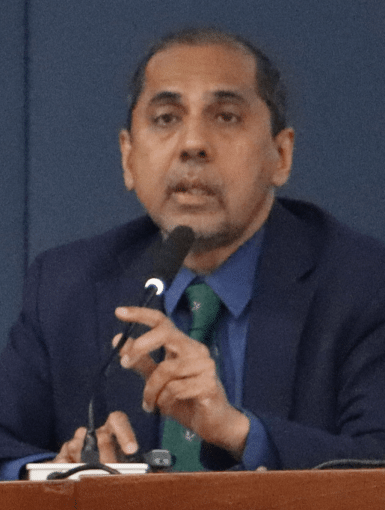
Sarang Shidore is director of the Global South Program at the Quincy Institute in Washington. He was also a member of the adjunct faculty at George Washington University, where he taught a class on the geopolitics of climate change. He currently also serves as co-chair in the think-tank track (T20) of the G20 meetings. Shidore's research focuses on the Global South in the global order, Asian security and energy/climate geopolitics. He has published in Foreign Affairs, Foreign Policy, The New York Times, The Nation, South China Morning Post, The Diplomat, Council on Foreign Relations, Energy Policy, Energy Research & Social Science and other platforms and outlets.
Prior to his current role, Shidore was director of studies at the Quincy Institute, senior research scholar at the University of Texas at Austin and senior global analyst at the geopolitical risk firm Stratfor Inc. He previously also spent 15 years in engineering and product management in the technology industry working with clients across three continents and serving as vice-chair in an international standards committee.