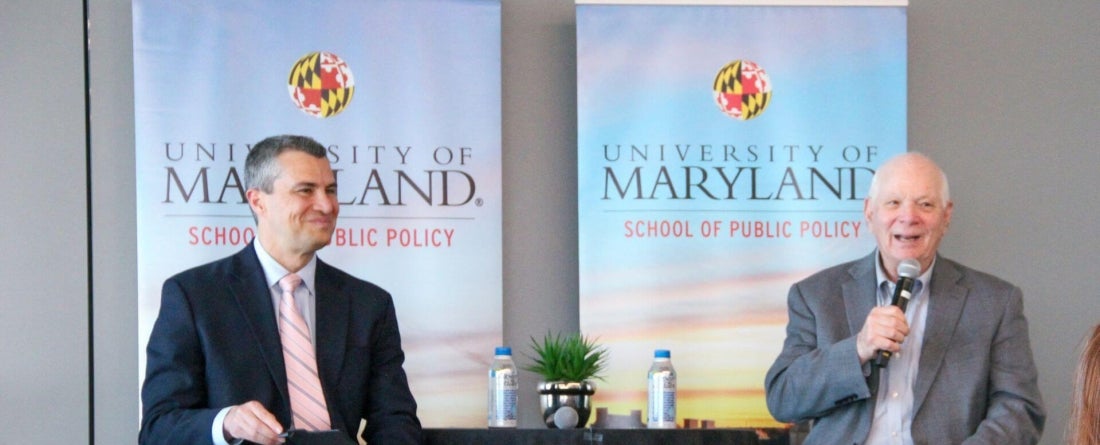
With wars unfolding abroad and democratic norms under strain in many parts of the world, former U.S. Senator Ben Cardin told students at the School of Public Policy that the United States is at a moment that will test its leadership abroad and the resilience of its democratic institutions at home. Cardin was the inaugural speaker at the Dean’s Distinguished Speaker Forum, reflecting on rising global conflict, declining trust in government and the growing role of misinformation in politics.
“Freedom House does a survey every year,” said Cardin. “We’re now in the 15th consecutive year of the decline of democratic states in the world.” The trend is unfolding as geopolitical tensions intensify and democratic norms are being questioned, including the United States.
The discussion, moderated by Dean Gustavo Flores-Macías, ranged from healthcare affordability and environmental policy to nuclear proliferation and the future of American democracy.
Much of the conversation focused on trust, particularly whether Americans still believe government decisions are based on facts rather than political narratives. “Everyone is entitled to their own opinion, but not their own set of facts,” Cardin said, citing a warning he said is often attributed to the late Sen. Daniel Patrick Moynihan as he discussed the spread of misinformation in politics. Without credible sources of information and a strong independent press, he shared, it becomes harder for citizens to evaluate policies or hold leaders accountable.
Cardin also spoke about the rising cost of healthcare. Even in the wealthiest country in the world, many Americans are delaying medical care because they cannot afford it. “Recent surveys have shown that it is the number one concern of American families about what they can afford,” he said. “They are more concerned about being able to afford health care than housing.”
After World War II, he said, the United States helped build international institutions and alliances that promoted democratic governance and human rights. Those efforts, including the Marshall Plan and global human rights initiatives, reshaped the international system. “We decided that America would lead by promoting democratic values in international civic engagement,” said Cardin.
Cardin said the current political climate makes it harder for lawmakers to compromise, even though many successful policies in his career came from bipartisan cooperation. “Listening is more than just not shouting,” he shared. “You’ve really got to absorb. You’ve got to be respectful of people who have different views.”
Cardin retired from the Senate in January 2025 after representing Maryland for nearly six decades in state and federal office. His career included work on international human rights legislation, environmental policy and pandemic economic relief programs. Even after leaving elected office, he noted, the responsibility for protecting democratic institutions does not rest only with political leaders. “We all have a responsibility for civic engagement,” Cardin told attendees. “Follow your passion. Get involved. Join coalitions. Your voice will be heard. … Make our community better.”