
A delegation of graduate students, supported by the Center for International and Security Studies (CISSM) and Dean Gustavo Flores-Macías, recently participated in the U.S. Army War College’s 5th Annual Strategy Competition in Carlisle, Pennsylvania. The intensive, multi-day exercise was designed to challenge emerging leaders to develop policy-relevant solutions to complex security problems.
This was the School of Public Policy’s first entry into a strategy competition. The team included doctoral students Samuel M. Hickey and Samantha Custer, along with master’s students Claire Biffl, Clara Miller, Myles Nartey and Alice Nason.
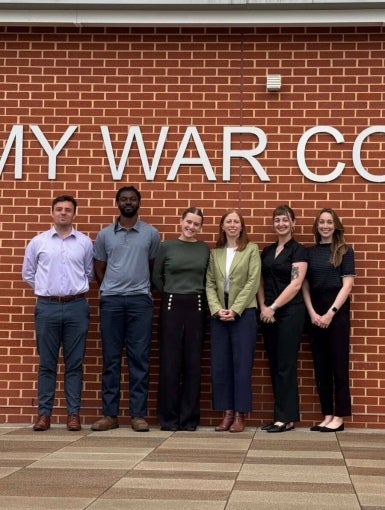
Competing alongside roughly twenty teams from policy and professional military schools across the United States, as well as participants from the French Ecole de Guerre, the SPP team was tasked with developing a strategy to counter terrorism in Sub-Saharan Africa. The three-day exercise required participants to balance political and military objectives, consider the perspectives of regional partners and anticipate the incentives and behavior of terrorist groups.
Given fiscal constraints at home and competing priorities abroad, one of the early hurdles the SPP team had to overcome was defining the problem in terms of what problem the United States wanted to solve and why policymakers should marshall resources to do so. Ultimately, the team framed the challenge around the risk that terrorism and regional instability could disrupt U.S. critical mineral and energy supply chains on the African continent.
Custer noted that the team’s diverse academic and professional backgrounds–from expertise in economic statecraft and nuclear deterrence to social policy and international security–helped them approach the problem from multiple vantage points. “We assumed that there would be limited appetite to ramp up boots on the ground without a clear exit strategy and began to think through alternative approaches to solving the problem,” she said.
Their proposed strategy prioritized interventions in states where U.S. supply chain risks were greatest, paired economic incentives with counterterrorism benchmarks for African partners, and emphasized strengthening Nigeria’s capacity to serve as a regional hub for counterterrorism training, joint operations, and intelligence sharing.
The competition offered a rare opportunity for SPP students to engage directly with how military institutions approach strategic planning and test how their policy training translated into that context. “I was hoping to better understand how military colleges prepare their students to approach strategic problems and how their solutions are communicated to senior decision-makers,” said Hickey. “Strategy is not simply about identifying an optimal answer; it is about constructing a defensible logic that connects assumptions, evidence, instruments and desired outcomes.”
Students emphasized that their training at the School equipped them with the analytical tools needed to think through tradeoffs, institutional constraints and implementation realities in response to the prompt. They credited coursework with SPP faculty and CISSM-affiliated scholars, including Alec Worsnop on civil conflict and Mike Woldemariam on development and security in Africa, as particularly relevant. At the same time, the competition pushed them to adapt these skills to a different professional environment.
Miller, who specialized in social policy, noted that translating what she had learned at SPP into a military context was challenging. “The biggest stretch for me was adapting an academic or policy strategy to a military context in a way that would be successful in that environment,” she said. This entailed being intentional about operational priorities and feasible recommendations.
The students highlighted the importance of interdisciplinary collaboration within their own group, as they worked together under time pressure to develop, refine and present their strategy.
“I enjoyed learning from my teammates as we worked to craft complex policy in a pressure-cooker environment,” said Biffl. “I was really impressed with the variety of thinkers that comprised our team, and I am proud of the product we ended up with.”
For Nartey, the experience was as much about personal growth as it was about strategy. “I went in with an open mind and just tried to enjoy the experience,” he said. “Even though we didn’t win, I learned a lot about my teammates and had a lot of fun.”
The experience underscored a broader lesson about the value of bridging civilian and military perspectives in national security decision-making. Differences in professional norms, vocabularies and approaches shape not only how solutions are developed, but how problems themselves are defined. Bringing those perspectives together strengthens both.
CISSM Director Nancy Gallagher, who also served as a guest judge for the competition, emphasized the importance of creating opportunities like this for students. “Preparing the next generation of scholar-practitioners,” she noted, “requires equipping students to navigate complex security environments, communicate across professional cultures and apply rigorous policy analysis to real-world strategic challenges.”